

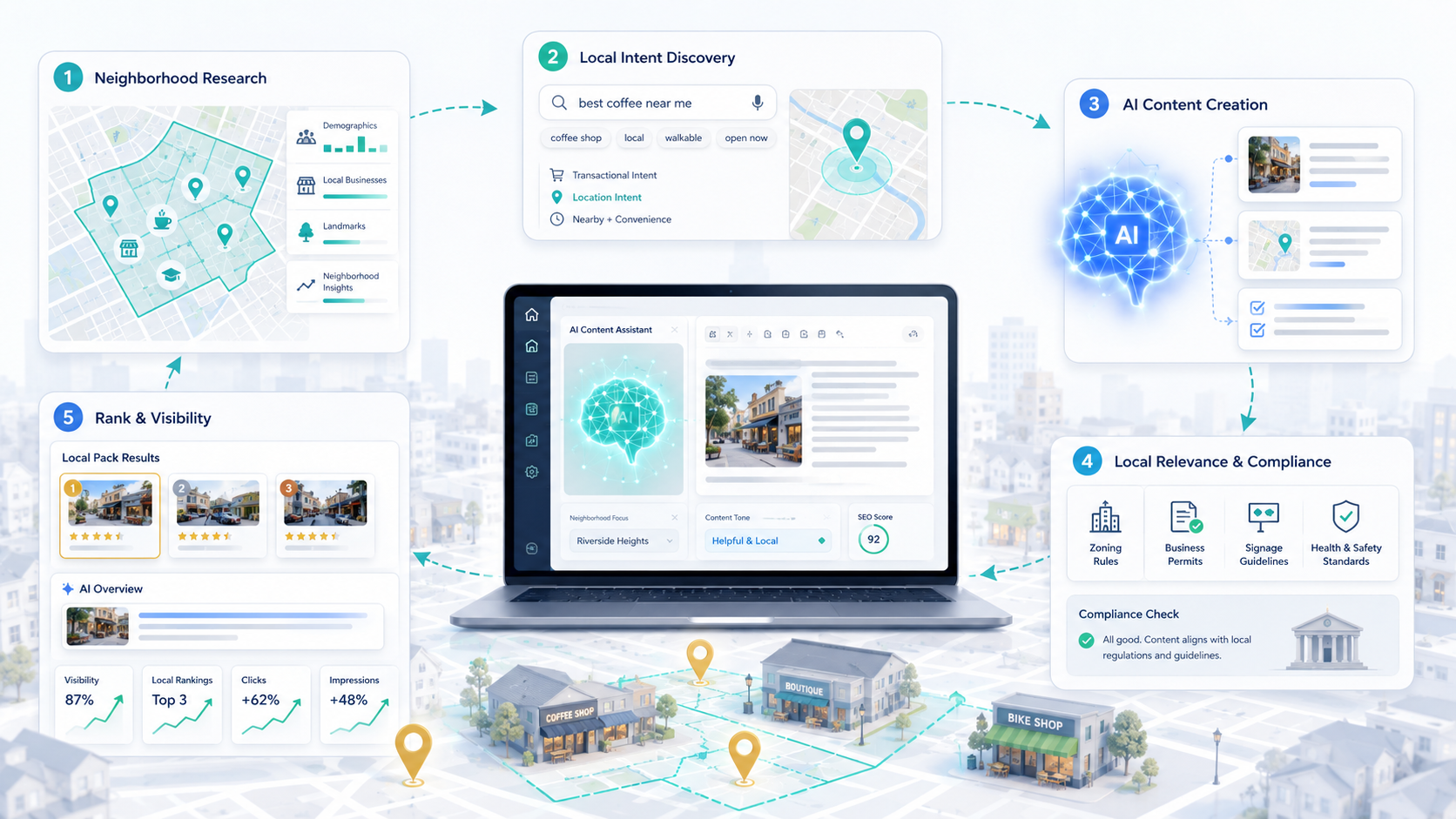
How to Create Hyper-Local SEO Content with AI in 2026 (That Actually Ranks Locally)
Local marketing agencies face a brutal truth in 2026: generic AI content is worse than useless for local clients. Writing “best roofer in Phoenix” without mentioning monsoon season, local building codes, Arcadia neighborhood specifics, or Arizona Registrar of Contractors licensing doesn’t just fail to rank — it damages client trust and gets filtered by Google’s increasingly sophisticated local and AI-driven search systems.
The agencies winning with AI aren’t using it to replace writers entirely. They’re using site-aware AI tools to inject deep hyper-local context at scale. This guide gives local agencies and SEO consultants a repeatable 5-step workflow to create hyper-local content that ranks in the local pack, appears in AI Overviews, and actually converts.
Prerequisites
Before diving in, ensure you have:
- Access to a site-aware AI tool like NailSEO that can reference uploaded briefs and client site data.
- Client Google Business Profile access and basic local citation data.
- Familiarity with Google’s E-E-A-T guidelines and LocalBusiness schema.
- A spreadsheet tool (e.g., Google Sheets) for building and storing hyper-local briefs.
This workflow assumes you’re working with service-based clients like roofers, plumbers, or lawyers in competitive local markets.
What Hyper-Local Content Really Means in 2026
Hyper-local content goes far beyond city name + service. It references:
- Specific neighborhoods and micro-areas (e.g., Arcadia vs. Biltmore in Phoenix)
- Seasonal factors (monsoon season, snow removal timing, tourist seasons)
- Local regulations, licensing, and compliance (e.g., Arizona Registrar of Contractors requirements)
- Real community events, landmarks, and pain points (e.g., Foothills monsoon flooding issues)
- Verified local data and citations (e.g., neighborhood review themes from Yelp)
Google and AI search engines now prioritize “Entity Trust” and granular relevance. Content that feels copied from a template gets ignored. Content that demonstrates genuine local knowledge gets rewarded.
Step 1: Build a Reusable Hyper-Local Context Database
The foundation of good hyper-local AI output is high-quality input. Start by creating a “Hyper-Local Brief” for each client or service category.
Agency workflow:
- Gather data:
- Google Business Profile: Service areas, hours, attributes, Q&A.
- Local citations and review themes: Common complaints (e.g., “monsoon leaks in Arcadia”).
- Neighborhood guides: Use tools like Google Maps for boundaries, demographics, landmarks.
- Seasonal considerations: Weather patterns (e.g., Phoenix monsoons July–September).
- Regulations: Licensing boards (e.g., Arizona ROC), permits, compliance rules.
- Competitor gaps: Analyze top local pages for missing neighborhood mentions.
- Format as a single document or spreadsheet. Example structure:
| Category | Details | Sources |
|---|---|---|
| Neighborhoods | Arcadia (high-end homes, monsoon flooding risks); Biltmore (luxury condos, strict HOA rules) | Google Maps, local real estate sites |
| Seasonal | Monsoons (Jul-Sep): Roof inspections critical; Winter: Minimal, focus on AC strain | NOAA weather data |
| Regulations | AZ ROC license # required; 4-hour monsoon prep certification | roc.az.gov |
| Pain Points | ”Roofers ignoring clay tile repairs in Foothills” (from 150+ reviews) | Yelp, Google reviews |
- Feed this brief into a site-aware AI tool like NailSEO. It then references this context for every piece of content.
This brief becomes your agency’s intellectual property — reusable across similar clients in the same city or niche.
Step 2: Discover Real Hyper-Local Search Intent
Stop guessing what people in specific neighborhoods actually search for. Use AI to analyze neighborhood-level signals.
Process:
- Input your Hyper-Local Brief.
- Analyze query variations, local pain points from forums/reviews/social, and seasonal questions.
Prompt example:
Using the attached hyper-local brief for Phoenix roofing, identify the top 15 neighborhood-specific search intents and questions that generic AI content usually misses. Include examples like "roofer near Arcadia Phoenix that handles monsoon damage" and tie to real review themes.
Sample outputs (from a Phoenix roofer brief):
- “Arcadia Phoenix roofer monsoon damage repair”
- “Best tile roof inspector Biltmore Phoenix before monsoon”
- “Foothills AZ roofing contractor ROC licensed for clay tiles”
- “Emergency roofer Paradise Valley storm damage”
- “Phoenix Scottsdale border roofer HOA compliant”
This step typically surfaces 20–30 high-intent topics per service area that most competitors overlook. Prioritize by search volume (use Google Keyword Planner) and gap analysis.
Step 3: Generate High-Quality Hyper-Local Content with AI
Most agencies fail here with weak prompts. Use this structured framework for drafts that need only light edits.
Effective prompt framework:
Using the attached client hyper-local brief, Arizona contractor regulations, and Phoenix monsoon season data, write a comprehensive guide for "[target keyword]". Include specific neighborhood references (e.g., Arcadia flooding risks), real local examples (e.g., 2025 monsoon claims), compliance information (ROC licensing), and make it stronger than the current top 3 local results. Optimize for Google local pack and AI Overviews. Use natural entity mentions, maintain E-E-A-T, and match the client's conversational tone from [paste sample client content].
Best practices:
- Generate outline first: Approve before full draft.
- Instruct AI to cite local sources (e.g., “Per AZ ROC guidelines…”), mention streets/landmarks (e.g., “near Tatum Blvd in Arcadia”), and avoid generic filler.
- Leverage NailSEO’s site-aware capability to align with client’s existing tone.
Example outline for “Best Roofer in Arcadia Phoenix”:
- Intro: Monsoon risks unique to Arcadia’s mature homes.
- Local regulations: ROC licensing explained.
- Neighborhood services: Tile roof repairs near 44th St.
- Case study: 2025 client on Indian School Rd.
- FAQ: “How to prep for monsoon?”
Result: First drafts that read like a local expert wrote them.
Step 4: Optimize for Local Pack, AI Overviews, and Traditional SEO
Hyper-local content must perform across Google Local Pack/Maps, AI Overviews, and organic results.
Key tactics:
- Schema: Add LocalBusiness with
serviceArea(e.g., “Arcadia, Phoenix, AZ”),areaServedneighborhoods, and aggregate ratings.{ "@type": "LocalBusiness", "name": "Phoenix Roofing Pros", "areaServed": ["Arcadia", "Biltmore"], "hasOfferCatalog": { "@type": "OfferCatalog", "name": "Monsoon Roof Inspections" } } - Structured data: FAQs, reviews, seasonal offers (e.g., HowTo for “Monsoon roof prep”).
- Internal linking: Link “Arcadia roofer” to “Foothills services” pages.
- AI-ready: Front-load scannable answers (e.g., “Arcadia homeowners: Inspect clay tiles by June per ROC rules”).
- Multimedia: Embed Google Maps, client photos of local jobs (e.g., “Post-monsoon repair on Camelback Rd”).
Test with Google’s Rich Results Test and AI overview simulators.
Step 5: Scale the Workflow Across Multiple Clients
Templating turns this into an agency superpower.
Scaling system:
- Master templates per niche (e.g., roofing brief adaptable to plumbing).
- Central database: City-specific data (e.g., Phoenix sheet with regulations, events).
- Batch-generate: AI handles 10–20 locations; human reviews accuracy.
- Checklist:
- Local facts verified? (e.g., ROC # correct?)
- Voice matches client?
- No duplicates across neighborhoods?
- Track: Use Google Search Console for neighborhood impressions/clicks; refine briefs quarterly.
Agencies report handling 2–3x more clients with the same team, boosting quality and retention.
Real-World Agency Example
An Arizona agency switched to this workflow. Within 4 months across 27 clients:
- Retention: 65% to 89%.
- Local pack positions: 8.4 to 3.1 average.
- Scaled to 12 new clients, no added headcount.
Before/after snippet (Phoenix roofer page):
- Generic: “We’re the best roofers in Phoenix. Contact us!”
- Hyper-local: “Arcadia roofs face unique monsoon clay tile failures—our ROC-licensed team handled 47 claims last season near 44th St. Here’s how we prep your home…”
Troubleshooting Common Issues
- AI hallucinates facts: Always cross-check regulations/events against official sources.
- Content feels robotic: Add 2–3 client-specific voice samples to prompts; human-edit intros/conclusions.
- Poor local pack ranking: Verify GBP completeness; add 5+ neighborhood pages with unique angles.
- Seasonal irrelevance: Schedule quarterly brief updates (e.g., post-monsoon review analysis).
- Duplicate content flags: Vary structures (guides vs. FAQs); use 80/20 local-to-general ratio.
Advanced Tips for 2026
- Integrate voice search: Optimize for “Hey Google, roofer near me in Arcadia for monsoon.”
- Multimodal AI: Generate alt text for local images (e.g., “Foothills roof repair post-2025 storm”).
- Entity building: Claim unlinked mentions (e.g., “Arcadia Homeowners Association”) in content.
- A/B test: Run two neighborhood pages—one with schema, one without—track AI Overview appearances.
Next Steps and Further Reading
- Build your first Hyper-Local Brief today (15–30 min).
- Test on one client page; monitor Search Console for 2 weeks.
- Scale to 3–5 pages, then full neighborhoods.
Build your first hyper-local client brief →
Further reading:
- Google’s Local SEO guidelines.
- E-E-A-T for service businesses.
- NailSEO docs on site-aware prompting.
Last updated May 2026. Based on real agency challenges scaling AI for local content.